

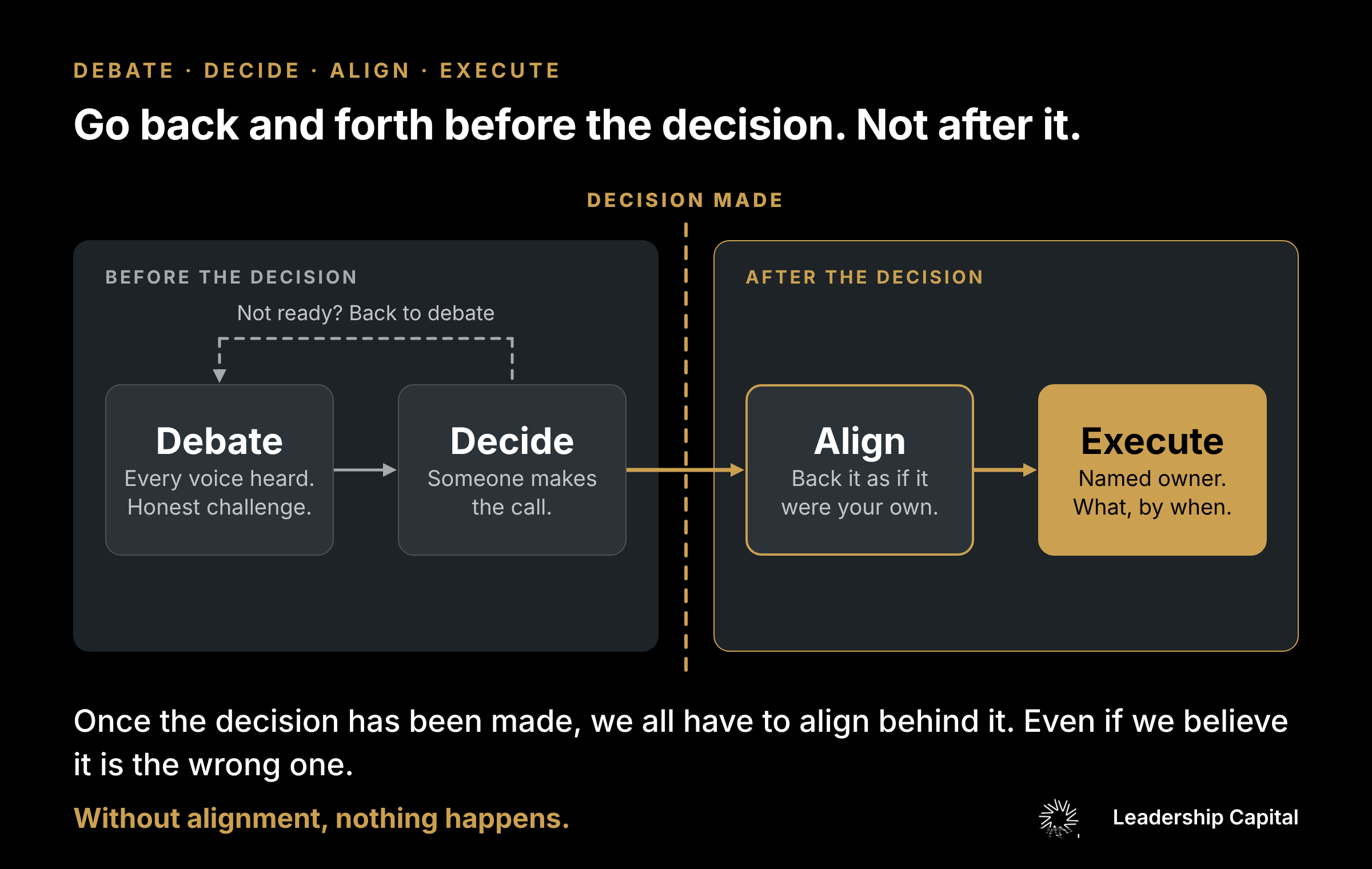
Debate. Decide. Align. Execute.
“You’re not listening to me.”
I’ve heard it in board meetings more than once. And the person it’s aimed at is clearly listening. They’re paying attention. They understand the argument. They’ve simply chosen to go a different direction.
That’s not a failure to listen. It’s a failure to understand the difference between being heard and getting your way.
One of the biggest impediments to execution inside organisations isn’t a lack of strategy, talent or ambition. It’s the inability to make decisions as a group.
Three ways it goes wrong
In my experience it goes wrong in three ways, and two of them sit with the CEO. Some are too decisive: there’s a bit of discussion, but really it’s for show, because we want to move forward as quickly as possible. Others struggle to make a decision at all, and the debate is endless.
The third failure sits with the team. People don’t understand the importance of being a good follower: sharing their view honestly, and then aligning behind what the group has decided, even when they disagree with it.
Being a good follower is as important as being a good leader.
When directive is right
There is a time for a very directive style in a boardroom: a crisis, when quick decisions have to be made. The Romans appointed a dictator when they were under extreme threat, and only for a limited period. That still works in certain contexts. It just shouldn’t become the default.
In the PE world time is not your friend, and that urgency can make taking control feel like the only option. But the fastest way to execute is to slow down, just long enough to make better decisions together.
When I facilitate off-sites or ExCo meetings, I often put four words on the wall: Debate. Decide. Align. Execute.
1. Debate
The purpose of any leadership meeting is to make decisions and make things happen. That starts with making sure everyone in the room has been heard, including the quieter, more introverted people who need to be invited in.
I worked with one PE-backed leadership team who would endlessly talk about the problem. They came at it from different perspectives, the debate went round, and then they ran out of time. There was never time left to wrap things up and agree actions that would make the problem go away.
What we left them with was simple. For difficult, knotty problems, the first 60 minutes may just be spent defining the problem from different perspectives and agreeing on it. If that’s all you do, great. Come back, having thought about it, with courses of action. We book 60 minutes in our diaries and think we can get a lot done. Often you just can’t.
But you need the grit and tenacity not to let it go. If it’s important, see it through, otherwise the whole conversation was a waste of time.
One of that team told me afterwards that they got better at moving from debate to decision, alignment and execution. It was challenging, because they had to undo habits that were ingrained, but it made a real difference to how they worked together and got things done.
2. Decide
How do you know the debate is done? People start to furiously agree with each other. They reinforce points that have already been made, using different language.
I set the expectation at the start that when I hear that, I’ll gently challenge it. Then I ask: it sounds like everyone has shared their perspective. What’s the decision? Who’s going to do what, by when?
Every decision is made with imperfect information. Delaying a decision is still a decision: you’re choosing to burn time. Sometimes that’s right, when key data is missing. Often it’s just discomfort in disguise.
3. Align
With alignment, it’s not so much what is said as what isn’t. Someone goes quiet. When I ask whether they agree, I get a throwaway line: “I’m not sure we’re on the same page.” You can tell they’re not going to back the decision as if it were their own.
So I go and have a quiet conversation with them outside the room, once the debate has passed. Sometimes you just have to listen and let the frustration come out. Then reinforce the point: you have been listened to, but a choice has been made. Part of being a professional is accepting that you can’t always have your own way.
Colin Powell put it well:
When we are debating an issue, loyalty means giving me your honest opinion, whether you think I’ll like it or not. Disagreement, at this stage, stimulates me. But once a decision has been made, the debate ends. From that point on, loyalty means executing the decision as if it were your own.
Colin Powell, My American Journey
But what if they were right?
Aligning doesn’t mean walking off a cliff together. When you make the decision, mark the points in the future that will tell you whether it’s working. If it’s working, we should see a return by here. If we don’t, we’ll give it more time or more resource. And here is the line we won’t cross. Set those lines as you decide, or you risk the sunk cost fallacy: good money and good time after bad.
It also helps to ask how easy the decision is to undo. If I lease the wrong car, handing it back is a bit painful but I’m not stuck with the bill forever. If I put my daughter in the wrong school, I’ll do everything I can to avoid it. But if I get it wrong, I can still make a change. There is usually more freedom to undo decisions than we realise, and if a decision is easy to undo, move quickly.
4. Execute
A decision should lead to action. Someone needs to take the lead. It needs to be clear who is doing what by when, even if the first step is more planning, or coming back with data and analysis. What matters is forward momentum, and that it’s recorded.
The least effective teams leave with actions like “everyone is to…”, “we should…” or “I’ll try and get that done.” The commitments are loose and owned by no one, so the decision never becomes action and nothing changes. Someone needs to grasp the nettle and make it happen.
Great teams make space for honest debate. Strong leaders make clear calls with imperfect information. Good followers commit fully, even when they argued against it. And someone owns what happens next.
That’s how you create the conditions for execution.
Share this article: